Buying Guides
6 Mistakes New Beauty Brands Make When Sourcing Makeup Brushes
This article outlines six common mistakes that new beauty brands make when sourcing makeup brushes.
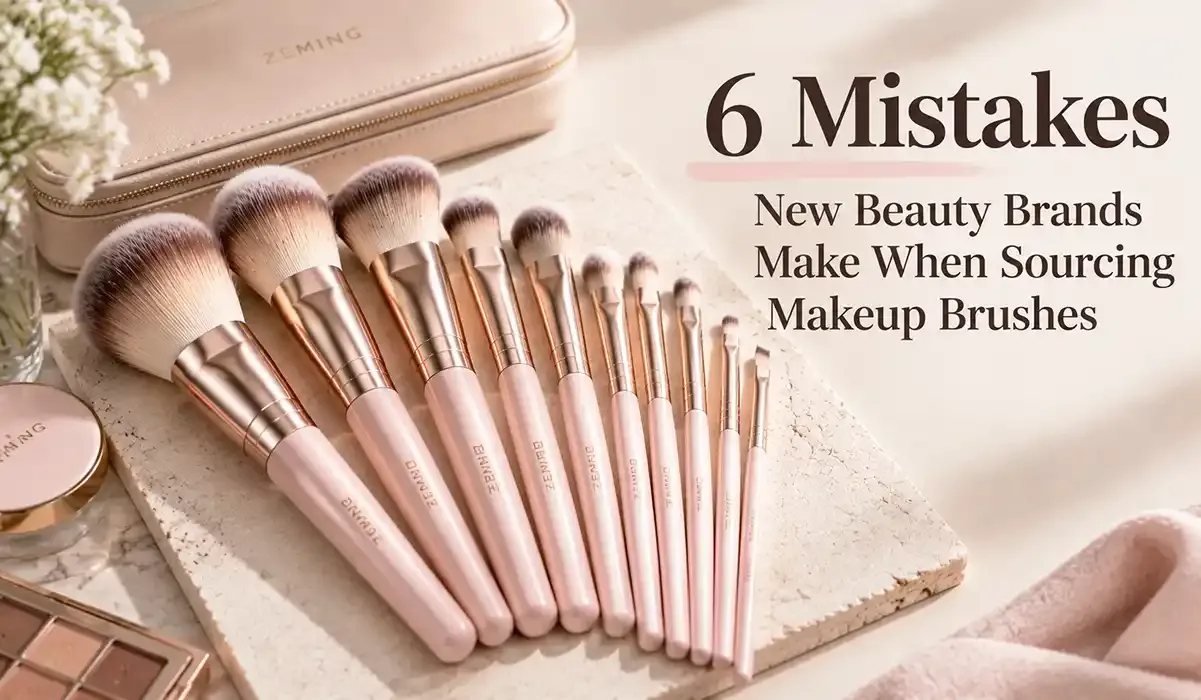
When sourcing makeup brushes, new beauty brands often focus their energy on logos, packaging, and handle color schemes—while overlooking the most critical aspects of the procurement process: brush head specifications, quality control systems, and intellectual property (IP) ownership. By reviewing the missteps of dozens of new brands, we have identified six recurring errors—ranging from leaving brush head decisions until the very end and mistaking sample quality for the standard for mass production, to being misled by "eco-friendly" labels. These issues may not surface during the sampling phase, but they tend to erupt once mass production hits the market. This article breaks down each of these pitfalls, helping you avoid costly detours.
Mistake 1: Leaving the Brush Head for Last
This is the most easily overlooked—yet costliest—mistake. When developing a brush line, new brands often prioritize the logo, handle color, and packaging design. Only after all these "visible" elements are finalized do they turn their attention to the brush head, treating it as an afterthought.
The problem is that almost every other decision regarding a makeup brush hinges on the brush head. The dimensions and structure of the packaging insert depend on the shape and size of the brush head; the length and weight of the handle are determined in relation to the brush head, rather than as independent aesthetic choices; and pricing and product positioning are derived directly from the grade of the fibers and the manufacturing techniques used. The brush head itself is dictated by a single factor: what product it is intended to apply, what formula it must work with, and who the end consumer is.
A logo can be changed in an afternoon; a brush head, once the mold is created, is nearly impossible to alter. Saving the most irreversible decision for last is the most expensive error a project can face.
The correct sequence: First, define the brush’s purpose (e.g., for liquid foundation or setting powder? For cream or powder formulas?). Next, determine the fiber type, density, shape, and tapering process. Only then should you move on to the handle, ferrule, and packaging. Once the brush head is set, everything else has a clear basis.
Mistake 2: Judging Mass-Production Quality Based on Samples
It is easy for a new brand to receive a high-quality sample and immediately place a bulk order. However, the discrepancy between a sample and the final mass-produced goods is one of the most common pitfalls in makeup brush procurement.
Some factories may meticulously craft a high-quality sample—using premium fibers and precise workmanship—only to switch to cheaper materials or cruder processes during mass production. A more subtle issue involves the "streamlining" (or omission) of the finishing process for the bristles: a sample might feature tapered fibers, while the mass-produced version uses flat-cut fibers. While the two may be nearly indistinguishable in photos or a quick tactile check, the difference becomes stark upon application—one feels soft and gentle against the skin, while the other feels like a scouring pad. The "softness" of brush bristles is not an inherent property of the fibers themselves; rather, it is the result of six or seven post-processing steps—such as tapering, grinding, and alignment. If any of these steps are skipped, the tactile feel of the same batch of fibers can vary drastically.
To address this, ensure your contract stipulates that the final bulk shipment must match the approved pre-production sample. Retain a reference sample, and arrange for mid-production inspections or third-party spot checks during mass production. Do not merely ask, "Can they produce a high-quality sample?" Instead, ask, "Can they replicate this exact quality 5,000 times over?"
Mistake 3: Focusing solely on the sample while neglecting the factory’s quality control (QC) system.
Many novice buyers fixate entirely on the sample, overlooking the factory’s systemic quality management capabilities. While a sample can be "meticulously crafted," the consistency of mass production depends on whether the factory maintains an independent quality control department and traceable inspection processes.
To determine if a factory’s QC is reliable, look for three key indicators: First, verify the existence of independent IQC (Incoming Quality Control), IPQC (In-Process Quality Control), and FQC (Final Quality Control) systems, and request to see recent inspection records. Second, check for authoritative certifications (such as ISO 9001) and, more importantly, their practical implementation—for instance, are there clear work instructions on the factory floor, and is inspection equipment regularly calibrated? Third, assess how specific they are regarding quality commitments; a truly capable factory will explicitly state which standards their products meet—such as REACH, RoHS, or CA65—rather than offering a vague, catch-all assurance like "we can do whatever the customer requires."
Bristle shedding is the primary reason for cosmetic brush returns. The root cause almost always lies in the assembly of the metal ferrule: if the epoxy resin is too cold or too viscous, it fails to penetrate the center of the bristle bundle, leaving the "inner" bristles unanchored. Top-tier manufacturers incorporate a vibration test into their QA process—placing assembled brushes on a vibrating platform for 60 seconds—to shake out any loose bristles before the products leave the factory. If your supplier lacks this step, the risk of shedding is effectively passed on to your end consumers.
Mistake 4: Prioritizing Aesthetic Specifications Over Performance Specifications
When communicating with manufacturers, new brands often focus on details like handle color, the specific shade of the metal ferrule, or the structural design of the packaging, while describing the brush head itself in vague terms—such as "softer synthetic bristles" or "something that feels like [Brand X]." Such ambiguous briefs leave too much room for interpretation by the factory. The resulting product might "technically" meet the specifications, yet consumers will find the bristles scratchy or uncomfortable when used on their skin.
Take synthetic fibers as an example: the difference in tactile feel between "tapered-tip" fibers and "flat-cut" fibers is profound. Under a microscope, the end of a flat-cut fiber resembles the opening of a tiny tube with sharp, defined edges; when dragged across the skin, it is perceived as rough. Tapered-tip fibers, by contrast, require additional chemical or mechanical processing to create a rounded, pointed tip. This significantly increases costs—a step often skipped in the production of low-cost brushes. If a brand merely specifies "soft synthetic" in its brief, it has no grounds to hold the manufacturer accountable if the delivered product uses flat-cut fibers.
The correct approach: Quantify performance requirements into verifiable metrics within the brief. This includes specifying the fiber type and grade (e.g., BASF synthetic fibers versus standard nylon), the tip treatment (tapered versus cut-tip), bristle density, the "spring-back" (resilience) level of the brush head, and an upper limit for shedding (e.g., ≤3 bristles per use). Aesthetic specifications are the brand’s domain, while performance specifications are the consumer’s concern—the latter should never be left to the manufacturer’s default settings.
Mistake 5: Relying on "Eco-friendly" and "Vegan" Labels Without Substantive Verification
In Western markets, compliance requirements for the environmental impact of beauty tools have shifted from being a "preferred" criterion to a mandatory barrier to entry. The EU’s Single-Use Plastics Directive (SUPD) explicitly restricts the import of non-biodegradable beauty tools, while California mandates that, starting in 2025, beauty tool packaging must contain at least 30% recycled material. However, there remains a significant "gray area" between a supplier’s eco-friendly marketing claims and the actual materials used. Common forms of misleading information include: "Recyclable" does not mean "biodegradable"; "plant-based" may refer to a product containing only 10% plant-derived material, with the remainder consisting of standard polypropylene (PP) plastic; and "vegan bristles" certification may apply only to the bristles, while the handle lacks any environmental certification—some suppliers might present an OEKO-TEX certificate for the bristles while conveniently omitting the fact that the handle has no such certification. Another frequent point of confusion involves the terms "cruelty-free" and "vegan": a brush might be entirely "cruelty-free" (not tested on animals) yet still feature bristles made from animal hair (making it "non-vegan"); these labels are not interchangeable.
How to rectify this: Demand a complete chain of certification from your supplier—such as GRS (Global Recycled Standard) for recycled nylon bristles (which requires a minimum of 50% recycled content); FSC certification for handles and paper packaging; and OEKO-TEX certification for fibers that come into contact with the skin. Do not accept "partial certification"; every individual component of a brush requires its own independent proof of compliance.
Mistake 6: Failure to Define Intellectual Property (IP) and Exclusivity Terms
Another structural error often made by new brands is conflating "private label" with "white label." Suppliers may market both as "custom services," leading brands to believe that changing the logo, color, or packaging results in a unique product. In reality, the core brush head remains entirely standardized, meaning competitors could easily source the exact same brush from the same factory. Brands may think they are building a competitive moat, when in fact they are merely engaging in basic white-labeling.
Even more serious are the risks concerning intellectual property. If a brand designs a unique brush head shape or handle structure, but the contract lacks clear non-disclosure agreements (NDAs) and clauses defining IP ownership, the factory could potentially supply that design to other clients. Furthermore, a brand might discover—upon switching suppliers—that it does not actually own the molds. In an OEM (Original Equipment Manufacturer) model, the brand typically retains full IP rights, whereas in an ODM (Original Design Manufacturer) model, IP ownership can be ambiguous or even belong entirely to the factory. This distinction must be clarified at the very outset of the partnership. Corrective measures: Sign a mutual non-disclosure agreement (NDA) before any design details are revealed; clearly define the ownership of molds within your contracts; choose between an OEM model (retaining full intellectual property rights while bearing the costs of mold development) or an ODM model (leveraging the manufacturer’s existing designs, while accepting the potential lack of exclusivity) based on your brand positioning; and for core products, consider registering design patents for the shape or structure of the brush heads.
The common thread among these six pitfalls is that they are structural errors rather than simple misjudgments in product selection. While issues like the wrong fiber type or color can be easily rectified, errors such as an incorrect development sequence, a lack of quality control systems, undefined IP ownership, or an incomplete compliance framework only reveal their true costs once mass production and market launch are underway—at which point, the expense of correcting them often far exceeds the product's profit margin. For new international brands, the core competency in sourcing makeup brushes lies not in "picking a good brush," but in establishing a controlled, end-to-end process—from the initial project brief to full-scale mass production.
If you are looking to source makeup brushes while avoiding these common pitfalls, please reach out to Zeming, a professional makeup brush supplier.