Buying Guides
Makeup Brush Ferrules: Why They Are So Important
This article provides a detailed analysis for makeup brush buyers on why the ferrule—the metal band connecting the bristles to the handle—is so important.
When a makeup brush becomes the subject of a customer complaint—whether due to shedding, a loose brush head, a rusted ferrule, or a detached handle—the root cause often lies in the ferrule itself or the assembly process used to attach it.
1. What Is a Makeup Brush Ferrule?
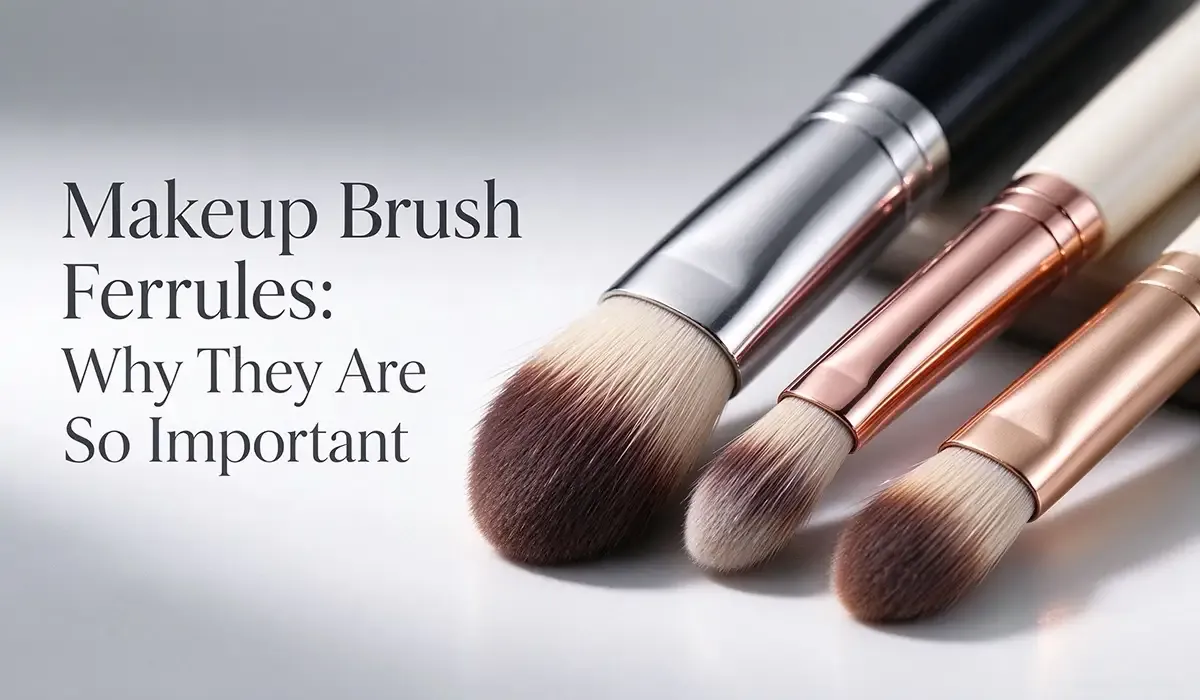
A makeup brush ferrule is a metal (or occasionally plastic) sleeve that connects the bristles to the handle. A standard makeup brush consists of three parts: the bristles, the ferrule, and the handle. The ferrule sits in the middle, encasing and securing the base of the bristles at one end, while connecting to the handle at the other.
2. The Function of a Makeup Brush Ferrule
(1) The ferrule secures the bundle of bristles firmly within its cavity—typically through crimping and the use of adhesive—and then joins the assembly to the handle. In axial pull tests, a high-quality ferrule for a face brush is generally required to withstand a force of 8–12 kgf, while a smaller eye brush should withstand 5–8 kgf. Inadequate anchoring typically manifests as bristle shedding, a wobbly brush head, or the head detaching entirely from the handle.
(2) The diameter, taper, and crimping method of the ferrule determine how tightly the base of the bristles is held. When a ferrule is crimped securely and the volume of bristles is well-matched to the internal cavity, the base of the bristles is held in a stable, compact shape. This directly influences the brush’s ability to pick up product, distribute it evenly, and blend edges. If the ferrule is too loose, or if the internal diameter does not match the volume of bristles, the base will be too slack—often causing the bristles to splay outward (“frizz”) during use or resulting in uneven product pickup.
(3) The bond between the bristles and the ferrule relies on epoxy resin or structural adhesive. The ferrule provides a relatively enclosed, protective mechanical space for this adhesive layer, shielding the bond interface from direct external impact during normal use. The durability of the adhesive layer itself depends on the type of glue used, the depth to which it is applied, and the curing process—all of which must be carefully coordinated with the design of the ferrule.
(4) The weight, surface texture, and color of the ferrule are among the first details a consumer notices when picking up a brush. Whether it is the lightweight, budget-friendly feel of an aluminum ferrule versus the substantial, weighted feel of a brass one, or the luster and refined finish provided by electroplating or anodizing—these elements play a direct role in how a consumer judges whether a brush is worth its price.
3. Durability and Lifespan of Makeup Brush Ferrules
In the mass market, the wall thickness of ferrules is typically 0.30–0.45 mm for aluminum, 0.30–0.40 mm for copper, and 0.25–0.35 mm for stainless steel. Based on our experience, aluminum ferrules with a wall thickness of less than 0.30 mm are prone to deformation during the crimping process. This can create microscopic gaps—often invisible to the naked eye—that eventually lead to a loose brush head during use.
Surface treatment determines the longevity of the ferrule’s appearance. Aluminum ferrules rely on anodizing (typically with a film thickness of 5–25 μm) to achieve color and basic corrosion resistance; copper ferrules generally require nickel or chrome plating; and stainless steel is typically polished or passivated. If the anodized or plated layer contains pinholes or is inadequately sealed, sweat and cosmetic residues can penetrate these defects, causing pitting and surface degradation.
Washing with water is the primary threat to the ferrule system. Water can seep into the gap between the ferrule and the handle, dissolving or weakening the internal adhesive. Simultaneously, the wooden handle may undergo repeated cycles of expansion and contraction due to water absorption, accelerating the failure of the connection. Improper drying methods—such as leaving brushes with the bristles facing upward, which allows water to pool inside the ferrule—further promote corrosion and the degradation of the adhesive. Providing clear cleaning instructions on product packaging or detail pages serves as an essential quality control measure to extend the effective lifespan of the ferrules.
4. Materials Used for Makeup Brush Ferrules
4.1 Aluminum Ferrules
Aluminum ferrules account for the vast majority of the market. Their advantages include being lightweight and highly malleable, allowing for the creation of complex, non-standard shapes and cross-sections. They are resistant to rust, and the anodizing process enables a wide range of colors and surface finishes (such as glossy or matte, brushed textures, laser engraving, and beveled edges). However, they also have clear drawbacks: their hardness and resistance to denting are only moderate. If the wall thickness is insufficient, they may crack during the crimping process; consequently, aluminum may not be the ideal choice for smaller brushes that require high-pressure crimping. Aluminum ferrules are suitable for mid-range and mass-market product lines, as well as for brush designs with complex shapes or those where weight is a critical factor.
4.2 Copper Ferrules
Copper ferrules generally outperform aluminum in terms of hardness, ductility, rust resistance, and luster. Their high ductility provides greater flexibility during the crimping process—they can be flattened significantly without cracking—making them particularly valuable for eyeshadow brushes or detail brushes that require deep-crimp shaping. When nickel- or chrome-plated, copper ferrules offer a substantial, weighted feel and high resistance to denting; they are a common choice for high-end lines looking to convey a sense of "solid craftsmanship." The trade-offs are a significantly higher cost compared to aluminum and a heavier overall weight.
4.3 Stainless Steel Ferrules
Stainless steel ferrules offer superior rust resistance without the need for electroplating. They are well-suited for product lines that emphasize "rust resistance" and "durability" as key selling points. However, they are the most expensive of the three options, and they offer less versatility in terms of processing techniques and surface finishes compared to aluminum or copper.
4.4 Plastic Ferrules
Plastic ferrules eliminate the environmental concerns associated with metal electroplating or anodizing processes. They are easy to manufacture and cost-effective; however, they fall short of metal ferrules in terms of structural strength and tactile quality, limiting their use in standard crimping processes and high-end product positioning.
5. Quality Assurance for Makeup Brush Ferrules
Quality assurance for ferrules cannot rely on a simple "visual check of a sample"; it requires measurable acceptance criteria.
The surface color of the ferrule should be uniform, free from bumps, pitting, stains, or cracks, and consistent in thickness. No adhesive should be visible. The seam must be smooth and perfectly aligned, and any printed text should be clear and complete. During factory inspections, buyers focus on whether the crimp marks are smooth, whether there is any noticeable color variation, and whether there are burrs or scratches along the edges. Such defects not only immediately diminish the perceived quality when viewed on a retail shelf but also serve as early indicators of an unstable crimping process.
Drop testing and fitment checks are also essential: the ferrule should be subjected to a drop from a standard height to ensure it does not dent, crack, or loosen from the brush handle or the brush bristles. At the same time, use calipers or a go/no-go gauge to verify that the clearance for the male-female fit between the ferrule and the brush handle is within the specified tolerance range.
6. Common Issues with Makeup Brush Ferrules and Their Solutions
Issue 1: Cracks appear on the aluminum ferrule during the crimping process or on the finished product; alternatively, crimp indentations vary in depth or are misaligned.
Solution: For brush models requiring high-volume crimping, switch to copper ferrules. For aluminum ferrules, ensure a wall thickness of at least 0.30 mm and lock in the calibration parameters for the crimping dies. Distinguish between "normal crimp indentations" and "cracks"—some indentations are inherent to the process and do not necessarily indicate a fracture; however, final approval must be based on post-crimping seal integrity and pull-force testing.
Issue 2: The ferrule (along with the bristles) rotates on or detaches from the handle, or the connection between the ferrule and the handle fails.
Solution: Specify a two-component epoxy as the structural adhesive, ensuring it penetrates at least 4 mm deep to cover the base of the bristle bundle. Use a dual-crimp method to securely lock both the bristle bundle and the handle in place. Before bonding, verify that the fit between the ferrule and the handle falls within specified tolerances; do not rely on the adhesive to "fill gaps" caused by dimensional inaccuracies.
Issue 3: The handle detaches from the ferrule, or the bristle bundle falls out of the ferrule, with visible failure of the adhesive layer at the connection point.
Solution: Standardize the curing conditions for the epoxy adhesive (e.g., curing for at least 24 hours at 23°C ± 2°C) to avoid the brittleness that can result from accelerated thermal curing. Additionally, include instructions for the consumer: advise against soaking the ferrule, and recommend hanging the brush with the bristles facing downward to air-dry after washing.
Issue 4: The electroplated or anodized surface develops rust spots, black marks, dullness, or localized peeling.
Solution: For copper ferrules, ensure a sufficient nickel underlayer (e.g., 5 μm or thicker) followed by a sealed electroplated finish to eliminate pinhole corrosion. For aluminum ferrules, ensure proper anodized film thickness and sealing quality; use salt-spray testing as an acceptance criterion. Advise consumers to wipe moisture from the gaps in the ferrule after washing and to avoid drying brushes with the bristles facing upward, which can cause water to pool inside the ferrule. Issue 5: Scratches on the surface of the ferrules, burrs along the edges, and noticeable color variation between batches.
Solution: Implement a procedure during incoming quality inspection (IQC) to retain samples from each batch for color comparison. Additionally, conduct 100% inspection or high-ratio sampling to check for edge burrs. Require the factory to implement protective separation measures for anodized/electroplated ferrules during assembly and packaging to prevent secondary scratching of the finished products on the production line.