Buying Guides
What Makeup Brush Is Best for Liquid Foundation? A Perfect Guide For Buyer
This article provides a detailed analysis for buyers on which makeup brush is best for liquid foundation.
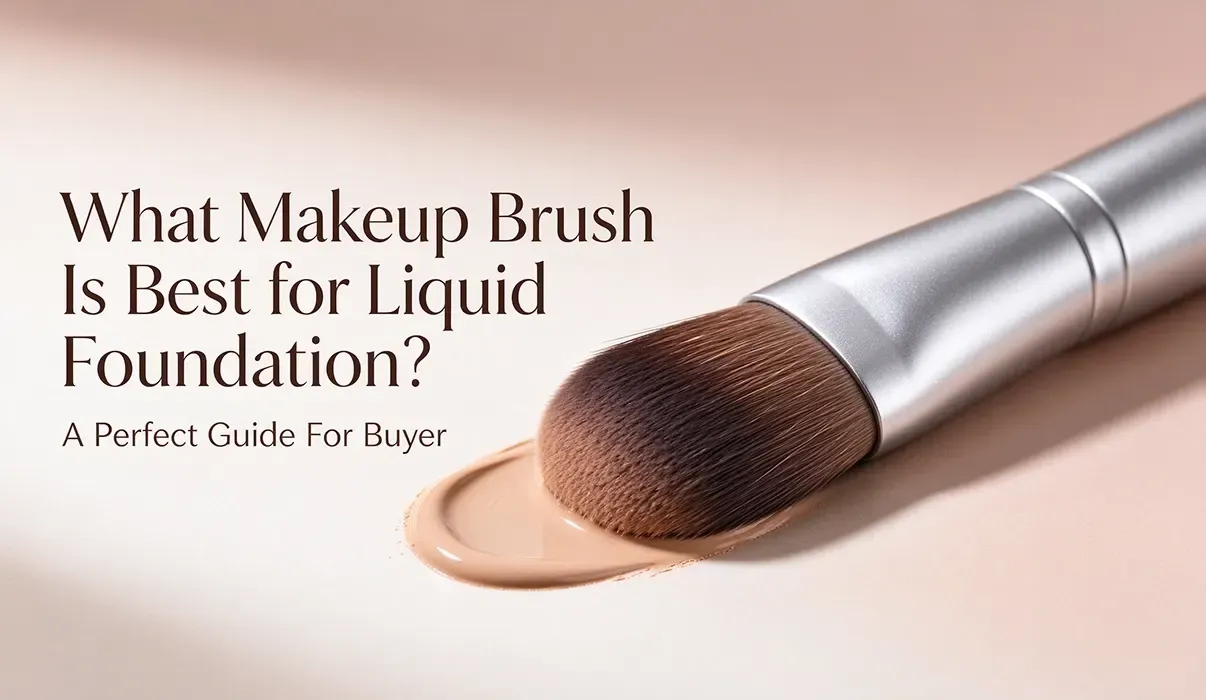
Among makeup tools, foundation brushes represent a category with a higher price point and a relatively lower replacement frequency, yet one where users are extremely sensitive to the actual experience. For buyers, there is no single answer to the question, "Which foundation brush is best?" The ideal choice depends on the foundation textures preferred by the target customer base, the specific makeup finish they desire, and their willingness to pay. This article categorizes foundation brushes by brush type and provides professional guidance for procurement.
1.Identify the bristle material of the foundation brush
Before analyzing brush shapes, one must first determine the material, as this establishes the baseline for procurement. For foundation brushes—intended for use with liquid, paste, or cream products—synthetic fibers (such as nylon, PBT, or polyester) are the only practical choice. While natural animal hair features cuticles that excel at picking up powder, using it with wet products like liquid foundation or concealer causes the bristles to mat; furthermore, such fibers absorb moisture and oils from the product, which damages the bristles and compromises the evenness of the application. In contrast, synthetic fibers are non-absorbent—they do not soak up the product, allowing the foundation to be "pressed" into the skin rather than being lost within the brush. Additionally, synthetic fibers are resistant to water and oil, easy to clean, quick-drying, and offer far greater consistency for large-scale quality control compared to natural hair.
Although foundation brushes made with animal hair occasionally appear in mid-to-high-end product lines—sometimes blended (e.g., gray squirrel hair mixed with goat hair) to improve texture—they fail to address the fundamental requirements for applying foundation. For procurement purposes, opting for brushes made entirely or primarily of synthetic fibers represents the safest, most reliable approach—one that caters to the broadest user base while minimizing the risk of post-purchase issues.
2.Three Main Types of Brushes
2.1 Tongue-Shaped/Flat-Paddle Brushes
Tongue-shaped brushes feature a flat, elongated, tongue-like head with medium-length bristles that offer moderate elasticity without being overly dense. They are best suited for fluid, lightweight liquid foundations and water-based cream foundations. The application technique involves "spreading" rather than "pressing"—quickly distributing the foundation into a thin, expansive layer to create a sheer, natural, and luminous finish.
The primary trade-off with this brush type lies in balancing efficiency with a streak-free result. While they spread foundation rapidly, improper technique can easily leave visible brush strokes, often necessitating a follow-up step with a sponge or a clean brush surface to buff out the product. Consequently, they require a certain level of skill from the user and are not considered "foolproof" tools.
Purchasing Advice: The quality of a tongue-shaped brush hinges on the flatness of its surface and the fineness of the bristle tips. Coarse bristles or uneven trimming will significantly exacerbate the issue of streaking. For synthetic fiber brushes, a dense arrangement of fine fibers (around 0.075mm in diameter) allows for a "press-and-spread" application that leaves no streaks; this serves as a benchmark for quality control. This category is highly specialized—the global market for tongue-shaped foundation brushes was valued at approximately $337 million in 2025 and is projected to reach $522 million by 2032. These brushes are well-suited for lightweight, everyday product lines, entry-to-mid-range price points, and as components in sets designed for use with hydrating liquid foundations.
2.2 Flat-Top/Round-Top Brushes
Flat-top or round-top brushes feature short, dense, and voluminous bristles, with a head that is either flat or domed. They offer a large contact area with the skin and allow for significant downward pressure. The application technique involves circular motions or pressing, which works the foundation "into" the skin’s texture and pores. This provides superior smoothing and coverage compared to tongue-shaped brushes. They are the ideal choice for thicker liquid foundations, cream foundations, and solid cream-to-powder foundations, and are particularly well-suited for users with skin imperfections who require higher coverage. From a manufacturing perspective, the primary competitive factors for flat-top or rounded-top brushes are bristle density and the treatment of the bristle tips. High-density brushes—featuring, for instance, anywhere from 10,000 to 200,000 individual bristles—ensure an even distribution of product and a seamless, skin-hugging feel. However, excessive density can compromise ease of cleaning and drying time; therefore, a careful balance between fiber fineness and arrangement technique is essential. Some products utilize ultra-fine synthetic fibers (around 0.03mm in diameter) to achieve a soft touch and a level of precision that allows the bristles to reach into pores. Flat-top brushes represent a core segment of the global foundation brush market, standing alongside flat, angled, and kabuki-style brushes.
Our procurement recommendations focus on three key aspects: density, bristle length (typically on the shorter side, around 2.5–3 cm), and the roundness of the bristle tips. If a high-density flat-top brush has poorly finished tips, it may feel prickly against the skin during circular application, which directly leads to higher return rates. These brushes are well-suited for mid-range to premium-tier functional product lines, marketed with claims such as "pore-blurring," "high coverage," or "creamy, flawless skin." They are also excellent candidates for bundling with cream-based foundations or inclusion in makeup brush sets.
2.3 Angled Brushes
Angled brushes feature a slanted head; while the bristles are dense, the tip is cut at a distinct angle. Their unique value lies in their versatility—they are capable of both broad-area foundation application and detailed work. The pointed edge allows for precise application in curved or tight areas, such as around the nose, eyes, and mouth, while the broader, flatter surface is ideal for covering larger areas like the cheeks. Furthermore, the angled design is naturally suited for contouring, allowing users to apply foundation and blend contours in a single stroke—a major draw for those seeking a "quick makeup routine with added dimension."
The manufacturing challenge for angled brushes lies in the precision of the slanted cut. If the angle is too steep, the brush loses its ability to handle fine details; if the angle is too shallow, its efficiency for covering large areas decreases. The stability of the cutting die and the integrity of the bristle tips after the angled cut are the primary factors that determine product consistency and the overall user experience. Some high-end products feature a graduated trim—transitioning from shorter to longer bristles—to deliver multi-layered functionality within a single brush head, ranging from pore concealment to seamless skin-texture blending.
When sourcing, consider the following: the angle of the slant (typically between 30° and 45°), the integrity of the bristle tips along the slanted edge, and how well the brush head width fits the contours around the nose. Another sourcing advantage of slanted brushes is that they share certain manufacturing processes with contour brushes; this allows for product-line expansion on the same production line, thereby reducing costs related to mold development and scheduling. Ideal positioning: a differentiated mid-range product line, targeted at users with some makeup experience and marketed as a "versatile base-makeup tool."
3.Two factors that are easily overlooked but influence purchasing decisions
First, consider the compatibility between the texture of the liquid foundation and the brush design. If purchasing decisions are based solely on the brush shape—without accounting for the specific foundation textures used by the target consumer base—it can easily lead to a mismatch: the brush itself may be perfectly functional, yet users fail to achieve the desired application results. It is a well-validated principle that highly fluid foundations pair best with tongue-shaped or flat brushes, while thicker, more viscous foundations are better suited for flat-top, rounded, or angled brushes. For companies that also sell liquid foundations, curating brush assortments based on foundation texture—rather than relying on a single brush type across all sales channels—will yield greater efficiency.
Second, hygiene features and eco-friendly materials are increasingly becoming essential requirements—not merely optional "nice-to-haves"—in the procurement process. Synthetic fibers naturally align with "vegan" and "cruelty-free" positioning; furthermore, antimicrobial fiber treatments (such as those infused with silver ions) and bristles derived from bamboo or charcoal are now appearing in mid-to-high-end product lines. Meanwhile, the large-scale sourcing of biodegradable fibers—such as those made from corn or bamboo—is already being implemented by some manufacturers, offering potential cost efficiencies. For buyers, prioritizing suppliers who offer antimicrobial or eco-friendly material options—even for standard brush shapes—creates a valuable point of differentiation for retail displays and e-commerce product pages, all without significantly increasing procurement costs.